
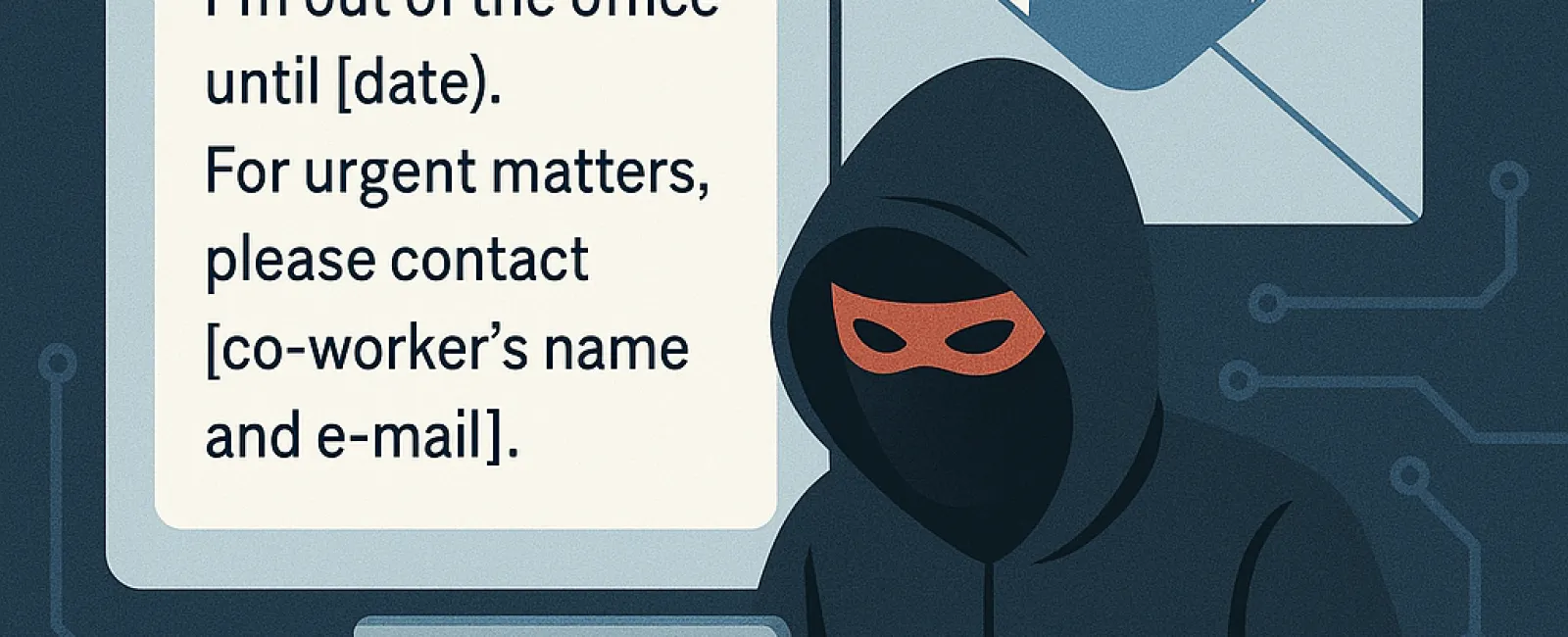
Set your out-of-office message and relax. But as you prepare for your vacation, your automatic reply quietly announces to the world:
"Hello! I'm away from the office until [date]. For urgent concerns, please reach out to [coworker's name and e-mail]."
It seems helpful and harmless, right?
Unfortunately, this is exactly the kind of information cybercriminals crave.
Your automatic reply, designed to keep communication smooth, can inadvertently provide hackers with valuable details to exploit.
Consider what a typical out-of-office message reveals:
● Your full name and job title
● The exact dates you'll be unavailable
● Names and email addresses of alternate contacts
● Insights into your team's internal structure
● Sometimes even personal reasons for your absence (e.g., "I'm attending a conference in Chicago…")
This information gives cybercriminals two critical advantages:
1. Perfect Timing: They know when you're away and less likely to detect fraudulent activities.
2. Precise Targeting: They can impersonate the right individuals and tailor scams effectively.
This sets the stage for sophisticated phishing or business email compromise (BEC) attacks.
Typical Scam Scenario
Step 1: Your auto-reply is triggered and sent out.
Step 2: A hacker uses this info to impersonate you or the listed alternate contact.
Step 3: They send a fraudulent "urgent" request for wire transfers, passwords, or confidential documents.
Step 4: Your colleague, unsuspecting, believes the request is genuine.
Step 5: Upon returning, you discover a significant unauthorized transaction, such as $45,000 sent to a fake vendor.
Incidents like this happen more often than you realize and pose even greater risks for businesses with frequent travelers.
If your team includes traveling executives or sales personnel whose communications are managed by assistants or admins, this creates ideal conditions for cyberattacks:
● Admins handle emails from multiple sources
● They regularly process payments, documents, or sensitive requests
● They often act quickly, trusting the apparent sender without thorough verification
A single well-crafted fake email can breach your defenses and lead to costly fraud or data loss.
Safeguard Your Business Against Auto-Reply Exploits
Instead of eliminating out-of-office replies, optimize their use with smart precautions. Here's how:
1. Keep Your Message Ambiguous
Avoid sharing specific travel plans or naming backup contacts unless absolutely necessary.
For example: "I'm currently out of the office and will respond when I return. For immediate help, please contact our main office at [main contact info]."
2. Educate Your Team
Ensure everyone understands:
● Never process urgent financial or sensitive requests based on email alone
● Always confirm unusual requests through a secondary method, like a phone call
3. Deploy Robust Email Security
Implement advanced email filtering, anti-spoofing technologies, and domain protection to reduce impersonation risks.
4. Enable Multifactor Authentication (MFA)
Activate MFA for all email accounts to block unauthorized access, even if passwords are compromised.
5. Partner With a Proactive IT Security Team
Work with IT experts who monitor login attempts, detect phishing threats, and identify suspicious behavior before damage occurs.
Enjoy Your Vacation Without Cybersecurity Worries
We specialize in creating cybersecurity solutions that protect your business, even when your team is away.
Click Here Or Give Us A Call At 1-310-798-0405 To Schedule A Free 15-Minute Discovery Call
We'll evaluate your security, identify vulnerabilities, and help you safeguard your systems so you can truly relax on your next vacation without fearing your inbox.


